How the NHS Works: A Beginner’s Guide for Nigerians in the UK
New to the UK? Learn how the NHS works, including registering with a GP, NHS 111, 999, A&E, prescriptions, dentists, pharmacies and when you may need to pay.
Auntie Tobi
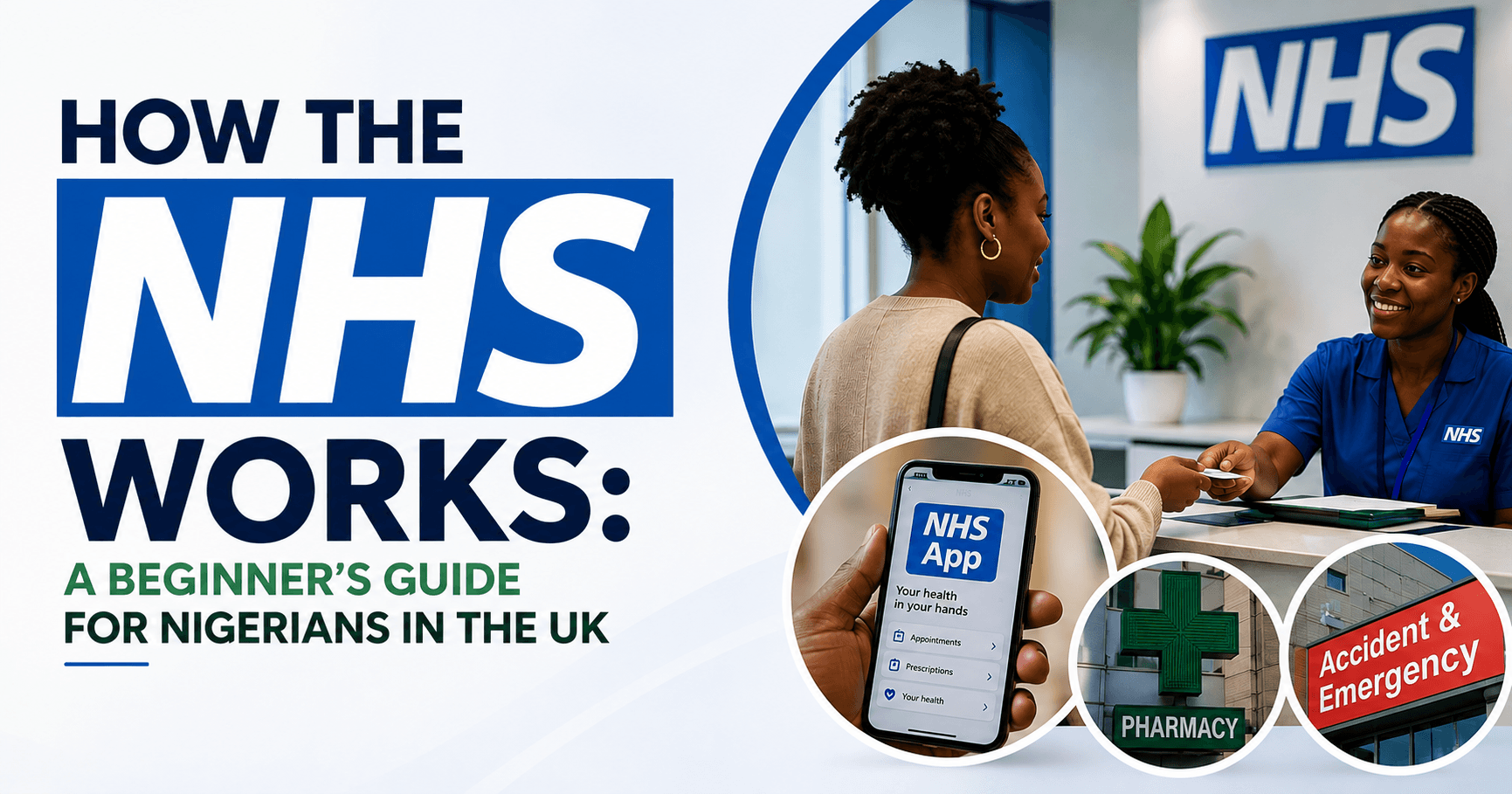
Moving to the UK comes with many new systems to understand, and healthcare is one of the most important.
You may hear people say:
“Healthcare is free in the UK.”
That is partly true, but it doesn't mean every NHS service is free for everyone.
If you've recently moved from Nigeria, understanding where to go when you're ill can save you time, money and unnecessary trips to A&E.
Here is Auntie Tobi's simple guide to navigating the NHS.
🏥 First: What Is the NHS?
The National Health Service (NHS) is the UK's publicly funded healthcare system.
However, healthcare is devolved, so England, Scotland, Wales and Northern Ireland have their own NHS systems and some rules differ.
This guide focuses mainly on NHS services in England.
For people who are ordinarily resident in the UK, many NHS services are available without paying at the point you receive treatment.
For people subject to immigration controls, entitlement can be more complicated. Many visa holders pay the Immigration Health Surcharge (IHS) as part of their visa application, which generally allows them to access NHS services on a similar basis to an ordinarily resident person while their visa is valid.
However, paying the IHS does not make every service free.
🩺 1. Register With a GP
One of the first things you should do after moving to an area is register with a GP — General Practitioner.
Think of your GP surgery as your main starting point for non-emergency healthcare.
Your GP can help with things such as:
ongoing health concerns
infections and illnesses
referrals to specialists
prescriptions
vaccinations
long-term conditions
mental-health concerns
pregnancy and family health
medical certificates and some forms
Do you need proof of address?
This is something many newcomers misunderstand.
According to the NHS, you do not need proof of address, immigration status, ID or an NHS number to register with a GP surgery in England.
A surgery may ask for identification or address information because it can help them find your records, but you should not be refused registration simply because you cannot provide these documents.
🔢 2. What Is an NHS Number?
Your NHS number is a unique number used to help healthcare professionals identify you and match you to your health records.
You don't need to memorise it.
And importantly:
You do not need an NHS number before you can register with a GP.
If you've previously received NHS care, you may already have one.
📱 3. Get the NHS App
Once you're registered with a GP, the NHS App can make managing your healthcare much easier.
Depending on the services available through your GP, you may be able to:
order repeat prescriptions
view parts of your GP health record
see test results
manage appointments
receive messages
access NHS services
You'll need to set up an NHS login and may need to prove your identity to access certain features.
💊 4. Your Local Pharmacy Can Do More Than Sell Medicine
Don't assume every illness requires a GP appointment.
Pharmacists can provide advice about many minor health problems and medicines.
In England, the Pharmacy First service also allows participating pharmacies to provide treatment for seven common conditions without you needing to see a GP first.
These include:
sinusitis
sore throat
earache in eligible children and young people
infected insect bites
impetigo
shingles
uncomplicated urinary tract infections in eligible women
Eligibility varies by condition, including age and other clinical factors.
💚 Auntie Tobi Tip: Before spending hours trying to get a GP appointment for a minor condition, check whether your pharmacist can help.
☎️ 5. When Should You Call NHS 111?
If you need medical help right now but you're not sure where to go, NHS 111 can help.
You can use 111 online or call 111.
Depending on your symptoms and location, NHS 111 may direct you to:
a pharmacy
your GP
an urgent treatment centre
an out-of-hours service
A&E
another appropriate healthcare service
If NHS 111 determines that the situation is life-threatening, emergency help can be arranged.
🚑 6. When Should You Call 999?
999 is for life-threatening emergencies.
Examples can include situations such as:
cardiac arrest
serious difficulty breathing
severe bleeding
suspected stroke
serious accidents
other immediately life-threatening emergencies
If someone's life appears to be in danger, call 999.
Don't avoid calling because you're worried about wasting someone's time when you genuinely believe there is a life-threatening emergency.
🏥 7. What Is A&E?
A&E means Accident and Emergency.
It is the hospital department for serious injuries and life-threatening emergencies.
A&E is not intended to replace your GP for routine medical problems.
If you're unsure whether you need A&E and the situation isn't immediately life-threatening, NHS 111 can help you decide where to go.
🩹 8. What Is an Urgent Treatment Centre?
Urgent treatment centres, sometimes called UTCs sit between routine GP care and A&E.
They can help with urgent problems that need attention but are not life-threatening.
Depending on the centre, this can include problems such as:
suspected broken bones
sprains and strains
cuts
minor burns
skin infections
minor head injuries
other urgent illnesses and injuries
Some centres accept walk-ins, while others may use NHS 111 to arrange appointments.
💷 9. Is NHS Healthcare Completely Free?
No — and this is important for newcomers to understand.
Many NHS services are free at the point of use for people entitled to them, but there are services in England where charges commonly apply.
These can include:
💊 Prescriptions
Most working-age adults in England who are not exempt pay an NHS prescription charge.
Some people qualify for free prescriptions because of factors such as age, pregnancy, certain medical conditions or qualifying benefits.
🦷 NHS dentists
NHS dental treatment in England is not automatically free for every adult.
There are NHS dental charges, although some people qualify for free or reduced-cost treatment.
👓 Eye care
Routine NHS sight tests are also not free for every adult in England.
Some groups qualify for free NHS eye tests and help towards glasses or contact lenses.
So don't assume that paying the Immigration Health Surcharge means everything connected to healthcare is now free.
🦷 10. Finding an NHS Dentist Can Be Different From Finding a GP
Registering with a GP does not automatically register you with a dentist.
You'll need to find a dental practice providing NHS treatment.
Availability can be difficult in some areas, so you may need to contact several practices.
You can search for NHS dentists through the NHS website.
If you need urgent dental treatment and cannot find a dentist, NHS 111 can advise you about appropriate urgent dental services.
👶 11. What About Children?
Children can access NHS healthcare too.
Register your children with a GP rather than waiting until they become ill.
Depending on age and eligibility, children can receive services including:
GP care
vaccinations
NHS dental care
eye tests
hospital treatment
mental-health services
health and developmental support
In England, NHS dental treatment is free for people under 18, or under 19 and in qualifying full-time education.
🤰 12. Pregnant? Tell Your GP or Contact Maternity Services
If you discover you're pregnant, you can contact NHS maternity services to begin antenatal care.
In many areas you can self-refer directly to maternity services, meaning you may not need to wait for a GP referral.
Your maternity team can arrange antenatal appointments, screening and other pregnancy care.
🧠 13. Mental Health Support Is Part of the NHS Too
You don't have to wait until you're in crisis before asking for help.
Your GP can be a starting point for mental-health support.
In England, adults can also self-refer to NHS Talking Therapies for conditions such as anxiety and depression without necessarily seeing their GP first.
For urgent mental-health help, NHS 111 can also direct people to appropriate support.
💷 14. On a Low Income? Check the NHS Low Income Scheme
Even if you're working, you may be able to get help with certain healthcare costs depending on your circumstances.
The NHS Low Income Scheme can potentially help with:
NHS prescription costs
NHS dental treatment
sight tests
glasses and contact lenses
necessary healthcare travel costs
Eligibility depends on your circumstances.
The Simple NHS Guide to Remember
If you've just moved to the UK, think of it like this:
🩺 GP → routine and ongoing medical problems
💊 Pharmacy → medicines, advice and certain common conditions
☎️ NHS 111 → urgent help when you're unsure what service you need
🏥 Urgent Treatment Centre → urgent but non-life-threatening injuries and illnesses
🚨 A&E → serious injuries and emergencies
🚑 999 → life-threatening emergencies
That simple distinction can make navigating the NHS much easier.
💚 Auntie Tobi Says
One of the first things you should do when settling into the UK is understand how to access healthcare before you actually need it.
Register yourself and your children with a GP.
Download the NHS App.
Know where your nearest pharmacy and urgent treatment centre are.
Save 111 for urgent medical help when you're unsure where to go, and know that 999 and A&E are for serious or life-threatening emergencies.
Most importantly, don't rely solely on WhatsApp groups or what someone experienced several years ago. NHS services and eligibility rules can change.
📌 SAVE THIS
GP → Routine care
Pharmacy → Minor conditions & medicines
111 → Urgent advice/help
UTC → Urgent, not life-threatening
A&E → Serious emergencies
999 → Life-threatening emergency
Official Sources
NHS — Using the NHS if you've moved to England
NHS — Urgent and emergency care services
NHS prescription charges and exemptions


Comments(0)